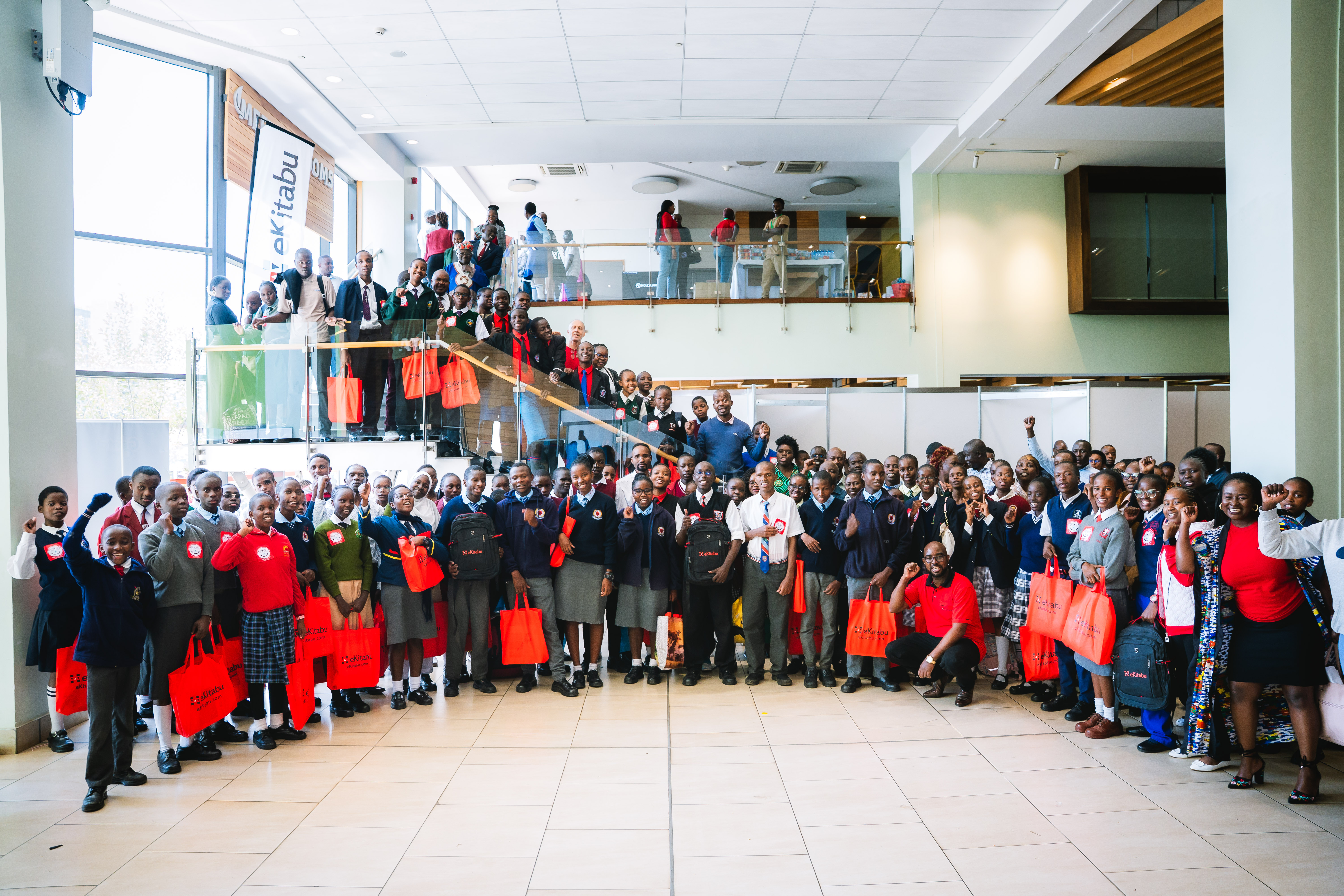
Inside the cavernous display hall of the Sarit Expo Centre in Westlands, surrounded by rows of publisher stalls, newly printed textbooks, and the hum of the Nairobi International Book Fair, a room full of adults sat listening to the voices of children. “The students—drawn from across the country—had finally stopped telling the adults what the latter wanted to hear.
On stage, the ceremony followed the expected choreography of institutional celebration. There were certificates, computing devices, scholarship cheques, and gift hampers. Dignitaries from Kenya’s Ministry of Education, publishing executives, and academic professors stepped up to the microphone in tailored suits. But underneath the formal protocols of the 14th eKitabu Digital Essay Competition lay a far more startling reality: a collection of 24,984 essays that read less like academic exercises and more like uncensored dispatches from the front lines of contemporary African youth.
Consider the text submitted by a student from a school in western Kenya. It did not offer the usual polite platitudes about hard work and discipline. Instead, the writer calmly detailed an open secret: how parents in their community were routinely asked to pay extortion bribes between Ksh5,000 and Ksh10,000 simply to facilitate exam cheating for their children.
It was a line that cut straight through the polite applause of an educational trade fair. The prompt given to students across Kenya’s primary, junior, and senior schools this year was deceptively simple: "Let me speak..."
It turned out that when you hand tens of thousands of young people three simple words of permission, they do not write marketing copy for their schools. They write about systemic corruption, acute fear, social isolation, bullying, and grief. They write about the quiet, heavy burdens of growing up in a world structured by adult compromises.
The scale of this year's response was unprecedented. A total of 24,984 essays flowed in from 43 of Kenya’s 47 counties drawn from more than 12,000 public and private schools, including remote institutions, special needs centres, and schools within refugee camps. Since its inception in 2013, the programme, created by local publisher eKitabu in collaboration with the Ministry of Education, has reached over 137,000 learners. But the 2026 edition marked a distinct departure in tone and texture.
For the first time in the competition's 14-year history, eKitabu introduced a Mother Tongue category. Alongside the established streams—English, Kiswahili, French, German, Arabic, Braille, Art, Kenyan Sign Language, and Mandarin Chinese—students were invited to write in the indigenous languages spoken in their homes and villages.
The response was immediate and overwhelming. The new category alone drew 371 entries across 34 mother tongue languages. All told, the contest captured 46 distinct languages, ranging from indigenous African tongues to international additions like Spanish, Hindi, Korean, and Japanese. French alone saw over 100 entries, German and Arabic more than 60 each, and Mandarin entries rose to 20 from just five the previous year.
"I am happy to be here and to see the recognition of African languages," said Prof. Mukoma wa Ngugi, author and professor of French at USIU-Africa, whose presence in the room carried a quiet historical resonance as the son of the late literary giant Prof. Ngũgĩ wa Thiong'o—a scholar who spent decades arguing that African literature must root itself in African languages to break free from colonial echo chambers.
To see children composing digital essays in Kikuyu, Dholuo, Luhya, or Kalenjin alongside Braille and Sign Language was to watch language restored to its primary human purpose: a tool for immediate, unmediated connection rather than academic gatekeeping.
"This will enhance the use of the mother tongue in writing and also in expression," said Michael Ng’eno, eKitabu’s Senior Manager in charge of Programmes.
Yet, the linguistic diversity was only half the story. In a year where educators worldwide are wringing their hands over the rise of synthetic text, generative chatbots, and automated homework, the organizers at eKitabu noticed a paradox.
"We saw less use of AI this year than in 2025," revealed eKitabu CEO Will Clurman. "We invited young people to speak in a way that was very open. They wrote about their lives, fears, struggles, hopes and ideas. The connection between written language and self-expression was there, and this is what makes this year’s submissions very special."
When faced with a prompt that demanded raw personal truth, the students intuitively understood what machine learning engines could not offer. An algorithm can generate a flawless analysis of a literary text or produce a sleek, corporate-sounding essay on civic virtue. It cannot, however, recount the specific humiliation of a classroom bully or the quiet despair of watching a family struggle to pay illicit exam fees. Faced with an invitation to be real, the children abandoned the synthetic safety of the prompt generator and picked up their own voices.
The panel of 65 expert judges tasked with evaluating the mountain of papers found themselves doing work that looked less like grading and more like listening to private confessions.
"The topic was good and encouraged students to write about issues affecting them—even in ways they find difficult to talk about with parents and teachers," said Beatrice Kikuyu, a teacher at Mary Lusweti Comprehensive School in Kakamega County who served on the judging panel. "Writing makes room to rethink the way guidance and counselling happen in schools."
In Kikuyu's observation lies the core transformation of the event. In many Kenyan schools, traditional channels of guidance and counseling operate under rigid hierarchies where children are expected to show deference rather than vulnerability. The blank screen or page, offered through the competition, became an anonymous back-channel—a space where students could bypass adult authority to report on adult failure.
The ceremony at Sarit Expo Centre brought together a wide constellation of figures from Kenya’s literary and educational establishment: Musyoka Muli, Chairman of the Kenya Publishers Association; Faud Ali, Chairman of the Kenya Primary Schools Heads Association; James Odhiambo, CEO of the Kenya Publishers Association; Olivia Deroint, Director of Alliance Française; and renowned author David Maillu.
Speaking on behalf of Fred Haga, the Director for Special Needs Education, Ministry official Sheila Lutta captured the atmospheric shift in the room with an evocative image: "The birds speak, the mountains speak. Nature reminds us that we can speak in many different languages."
When the formal speeches concluded and the 99 regional winners moved forward to collect their prizes, with another 125 finalists awaiting recognition in their home schools across the country, the mood in the hall remained markedly different from typical corporate award galas.
An event that began as an educational initiative designed to promote literacy and digital access had morphed into something deeper: a collective exercise in witness-bearing. In an era dominated by performative online presence and standardized testing, 24,984 young people proved that when given a genuine platform, they don't want to play along with adult pretense. They want to tell us who they really are.